Drop Scones (Scotch Pancakes)
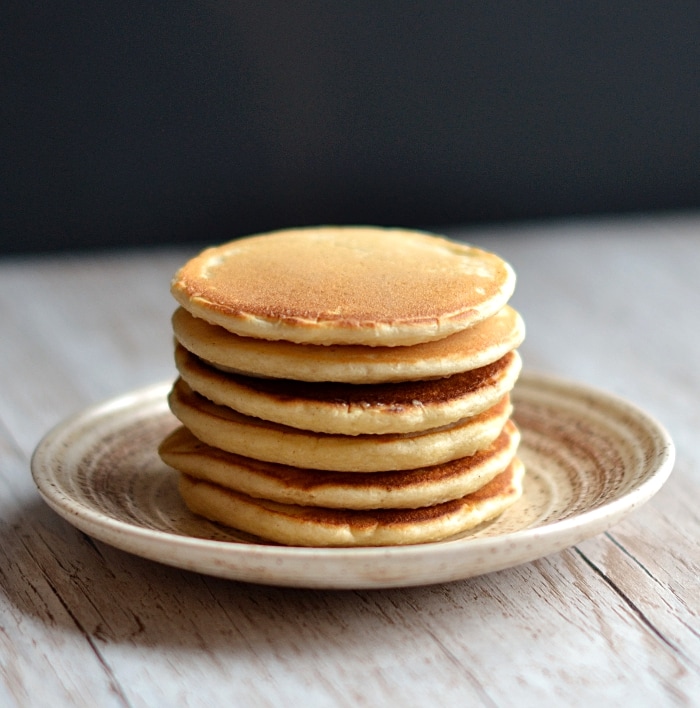
A favourite on Pancake Day, or on any day of the year. Drop Scones (aka. Scotch Pancakes) are delicious little pancakes that are easy to make and even easier to devour!
If there’s one type of baking I feel I’ve mastered, it’s pancakes!
I’ve even joked about writing my own recipe book, all about different pancake recipes. And it all started with these little beauties. Drop Scones, also known as Scotch Pancakes, are something I’ve been baking since my childhood and something that Granny has always been on hand to help perfect. Similar to American Pancakes but way simpler, they make a great treat for breakfast or just for snacking.
We best enjoy Drop Scones for breakfast, straight from the griddle with a little bit of butter on top. They also make great snacks for wee ones, topped with fruit, yoghurt or lashings of jam – our boys can’t get enough of them!
Best of all, you can even freeze them, popping them in the toaster for a minute or so to bring them back to life whenever you fancy one. And if you plan on batch baking some Drop Scones, then Granny’s top tip of adding a little oil to the batter is a clever way of stopping them from drying out and tasting stale.
So whatever your preference this Shrove Tuesday, you won’t go wrong with a plate of Drop Scones!
Ingredients for Scottish Drop Scones:
Self-raising Flour
Using self-raising flour instead of plain flour will give your Scotch Pancakes a little extra lift, keeping them nice and light.
Pinch of Salt
This works hand in hand with the raising agents in the flour, creating a chemical reaction that helps make bubbles in the pancakes, helping them rise.
Caster Sugar
These pancakes are definitely sweeter than they are savoury! Try swapping the sugar for Golden Caster Sugar for a more caramel-y taste.
Free-range Eggs
The traditional binder ingredient for Drop Scones. I don’t tend to stress too much about the size of eggs in a loaf cake, as long as they’re free-range. For vegan alternatives, see below.
Milk
The moisture in your batter! You can use whatever milk you have to hand, but for extra indulgent pancakes, opt for full-fat milk.
Oil
A little trick from Granny: pop a little oil into your batter before cooking, as it’ll stop the pancakes drying out, and they’ll keep better if you don’t finish eating the batch in one sitting.
Save this recipe!
Want to save this recipe for later? Pop your email below and come back to it when you’re ready to bake.
Drop Scones (Scotch Pancakes)
INGREDIENTS
- 220 g Self-raising Flour
- Pinch Salt
- 50 g Caster Sugar (Superfine Sugar)
- 2 Free-range Eggs
- 280 ml Milk
- 1 tbsp Sunflower/Vegetable Oil
EQUIPMENT
- Griddle Pan (or frying pan)
INSTRUCTIONS
- Sift the flour, salt & sugar into a large bowl.
- Whisk the milk & eggs together in a separate bowl with a fork and then gradually add them to the dry ingredients whilst mixing together. Once combined add the oil and mix again until just combined.
- Grease your griddle or frying pan with a little oil. Once hot, spoon a small amount of the batter (around 2 tablespoons) onto the gridle.
- Your pancakes are ready to flip once bubbles have started to pop on top & they appear dry. Using a spatula, flip the pancakes & cook the other side for around a minute or until a golden brown.
- Remove from the heat & enjoy with your topping of choice.
VIDEO
IMPORTANT NOTE:
All my recipes are developed using a digital scale and the metric system (grams and millilitres). Cup measurements are available as a conversion but these, unfortunately, won’t always be as accurate. For best results, I always recommend baking with a digital scale.
Tried this recipe?
Tag @bakingwithgranny or use the hashtag #bakingwithgranny!Love this? Try my British Pancakes recipe:

This is an addition to my former comment, and apologise : I asked a question about thickness but saw, too late, that someone ask the same. So I apologise and don’t need answer, since I got it.
MC
Great recipe, and an enormous thankyou for using metric system. I’ve no problem with cups for sugar or other ingredients whose density does not differ from a brand to another one, but for flour, cups are a nightmare : flours have different densities according to the the brands, the grind…, so, from one brand to another, a cup won’t have the same equivalent in grams. Going on cooking websites, you read that 1 cup of flour is 120 g,140 g, and even (and frequently) until… 170 g !!! And so, the result may be very different of what it should be (well, just for one cup, there is no incidence, but when you have to use 3 or more cups, that’s a real problem).
If someone gives a recipe in grams (I mean grams really weighted and tested by him, not an equivalence given by a calculator), there won’t be problem, because a gram is a gram, whatever would be the density of the flour, unlike the volume – a cup, for instance – according to this density, may lead to disappointing results (not enough flour, or too much flour).
I’m now going to test your drop scones, but I have a question : on websites I see drop scones really thicker (looking like nearly 2 cm thick). What the thickness come from, and how may I get it ?
Thankyou for answering, thanks to your granny, and have a nice Christmas time
MC
Hello from Brittany. First of all : sorry for my old fashioned and unprecise english, learnt more than 70 years ago and not practiced a lot, except with the Beatles, far ago, and now GB cooking, that I love.
I just cooked your scones this afternoon, because another recipe was a fiasco (the Queen one, yet ! :-) Too much flour). Perfect result with yours !!! Thanks a lot, and also : thankyou very very very much for using precise grams, instead of cups and spoons : I understand that, for people used to traditional cups and spoons, grams may look uneasy, but for my part, cups and spoons ARE the uneasy thing (well, for spoons, it depends, sometimes it’s OK, we also have spoons in France, but our problem is that they are not “standard” as yours : so, according to wheather it comes from your granny old times silverware, or from a modern low price shop, a spoon will have very different containing !!! Yours, at least, are “standard”, but when I read that a recipe needs “3 spoons butter”, I wonder how mesuring “spoon of butter” : have I to melt it ? :-)
Concerning the flour, the problem is that the way it goes into the cup, more or less “packed”, even if you don’t want to, may lead to a substancial difference with the recipe given. For cakes, the result may be deceiving, just because of that.
So, a double thankyou, Amy, I’ll come back to your website to see other recipes (and shorter comments, I sware !!!)
MC
I did this without sugar, and it was perfect. I think it even cooks better without the sugar. Served with defrosted frozen raspberries. It was amazing.
Hi regarding the pancakes my late mum made them on the girdle but I remember she used a potato cut in half to grease the pan & not oil.