Summarise & Save this Recipe on:
Summarise & Save this Recipe on:
The History and Nostalgia of School Dinner Desserts
When I first set out to make this recipe, I wondered if School Cakes were a thing of the past. My kids, however, informed me that you do still get School dinner Cakes at lunchtime, albeit not every day, nor after a ‘nutritious’ serving of Turkey Twizzlers and chips!
School dinners seem to have a generational divide. For me, a child of the 90s, school dinners were pizza, Turkey Twizzlers, Turkey Drumsticks, and turkey Dinosaurs (basically a lot of turkey!), plenty of chips, and buckets of beans.
Granny remembers mince, stew, cold meats, sausages and fish pie, all served with potatoes and veg – never chips!
These days, the boys’ school dinners consist of macaroni, fajitas, bubble fish, stir-fries, steak pie, and lots of fresh fruit and vegetables on the side.
What is a Traditional British School Cake?
One thing that is always a hit at school dinners, regardless of what generation you are from, is old School Cake!
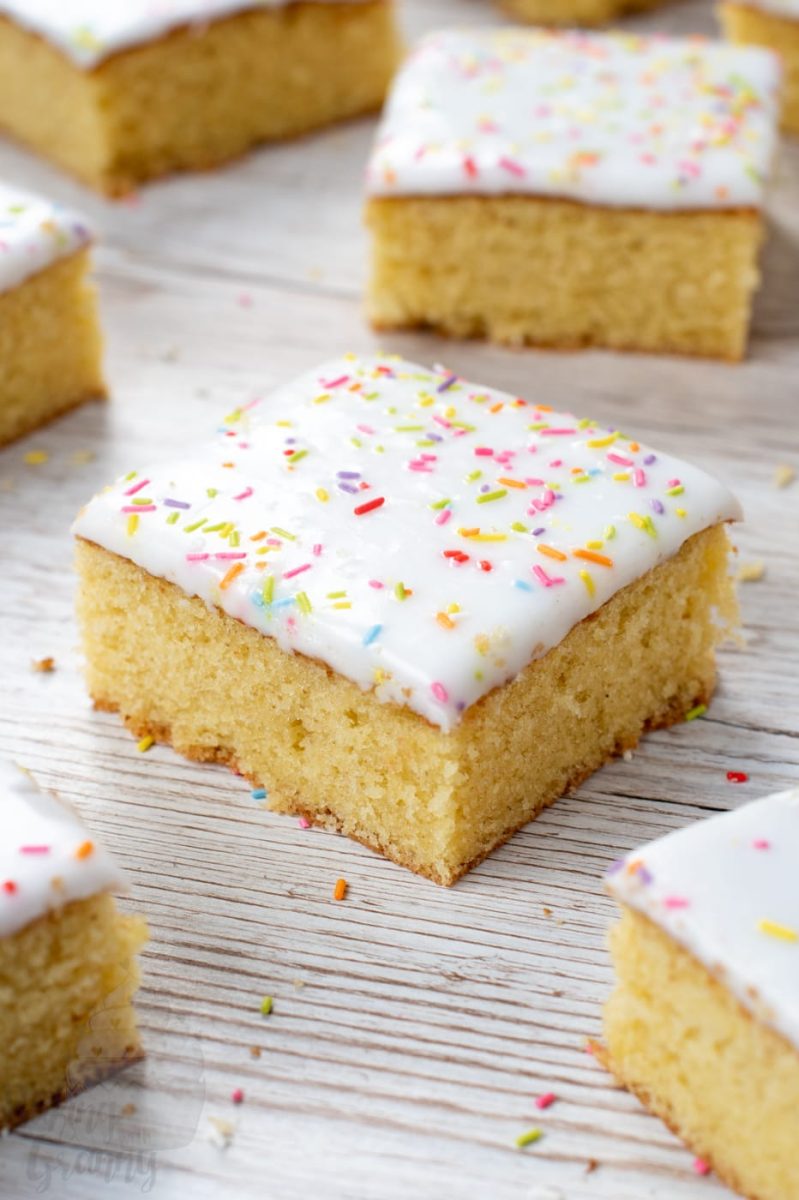
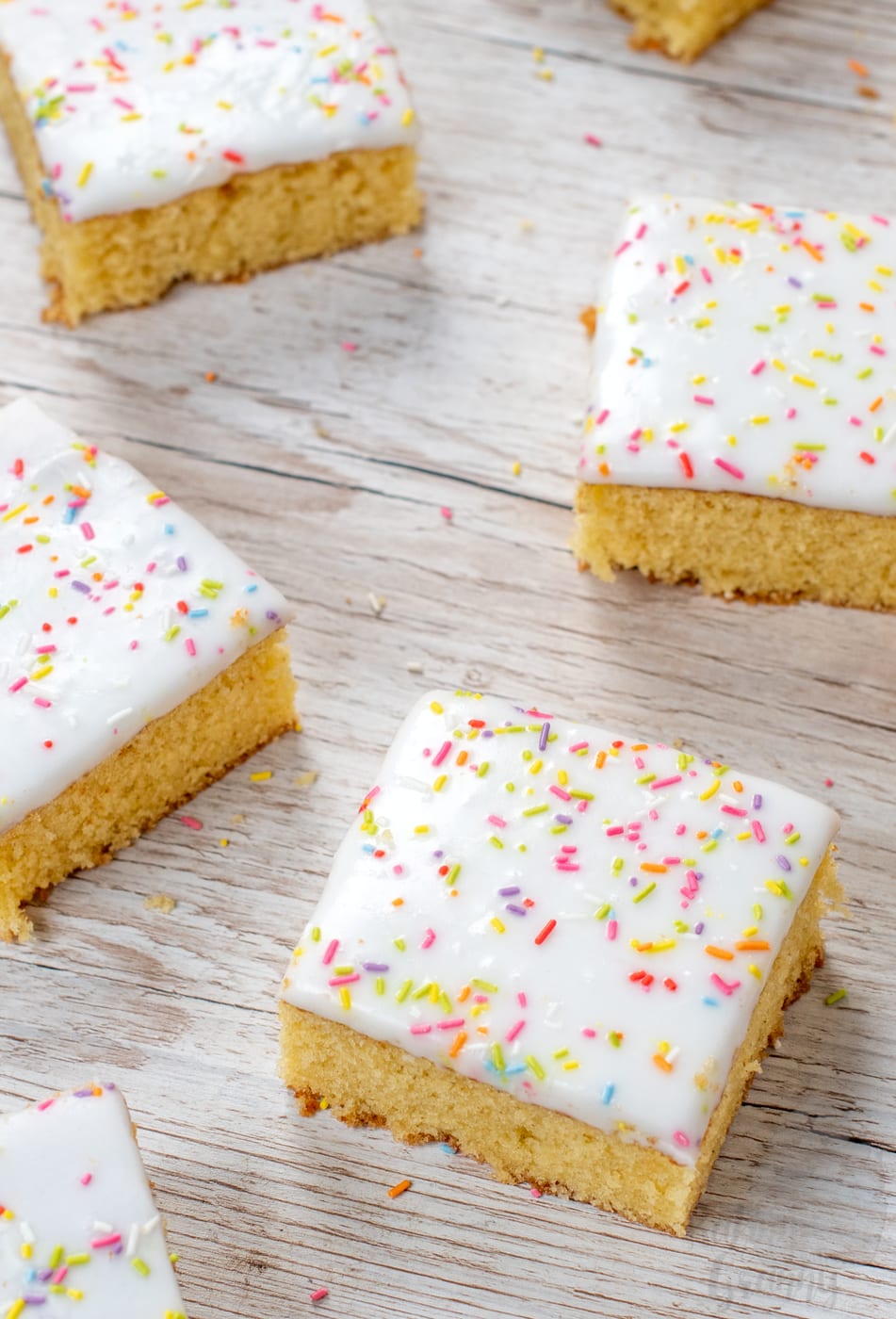
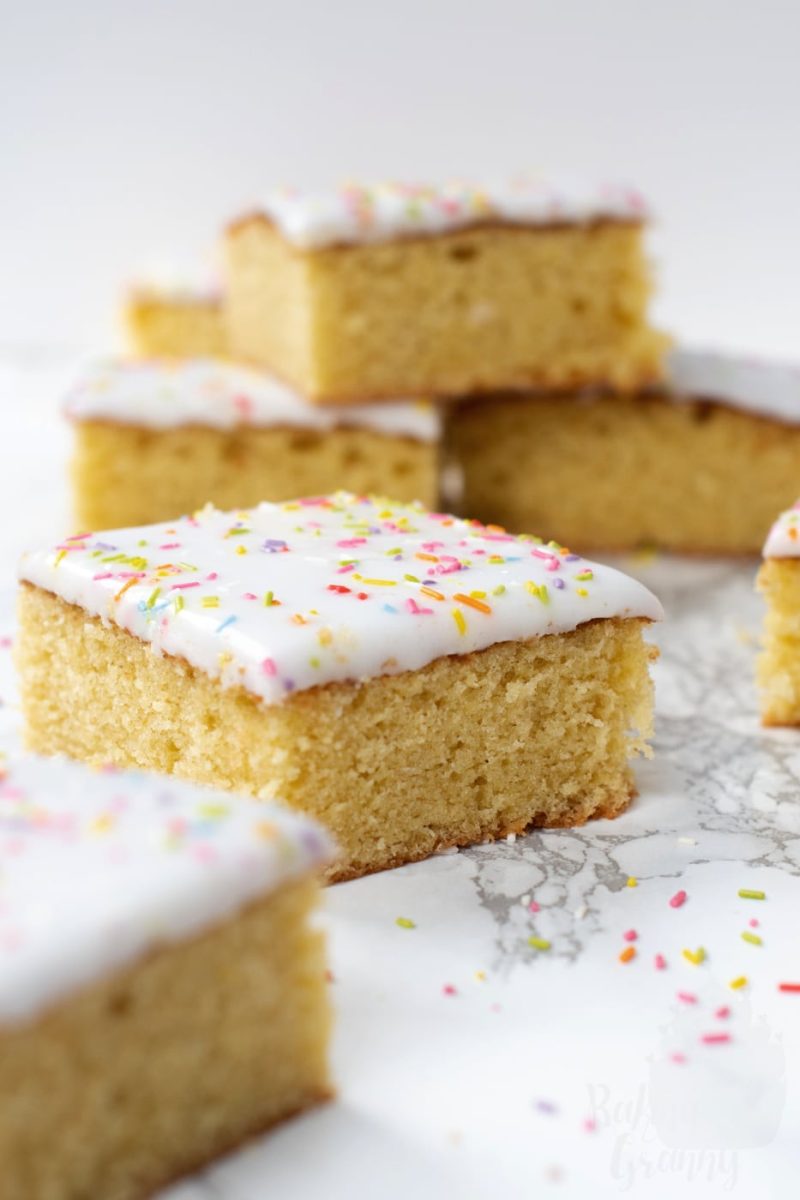
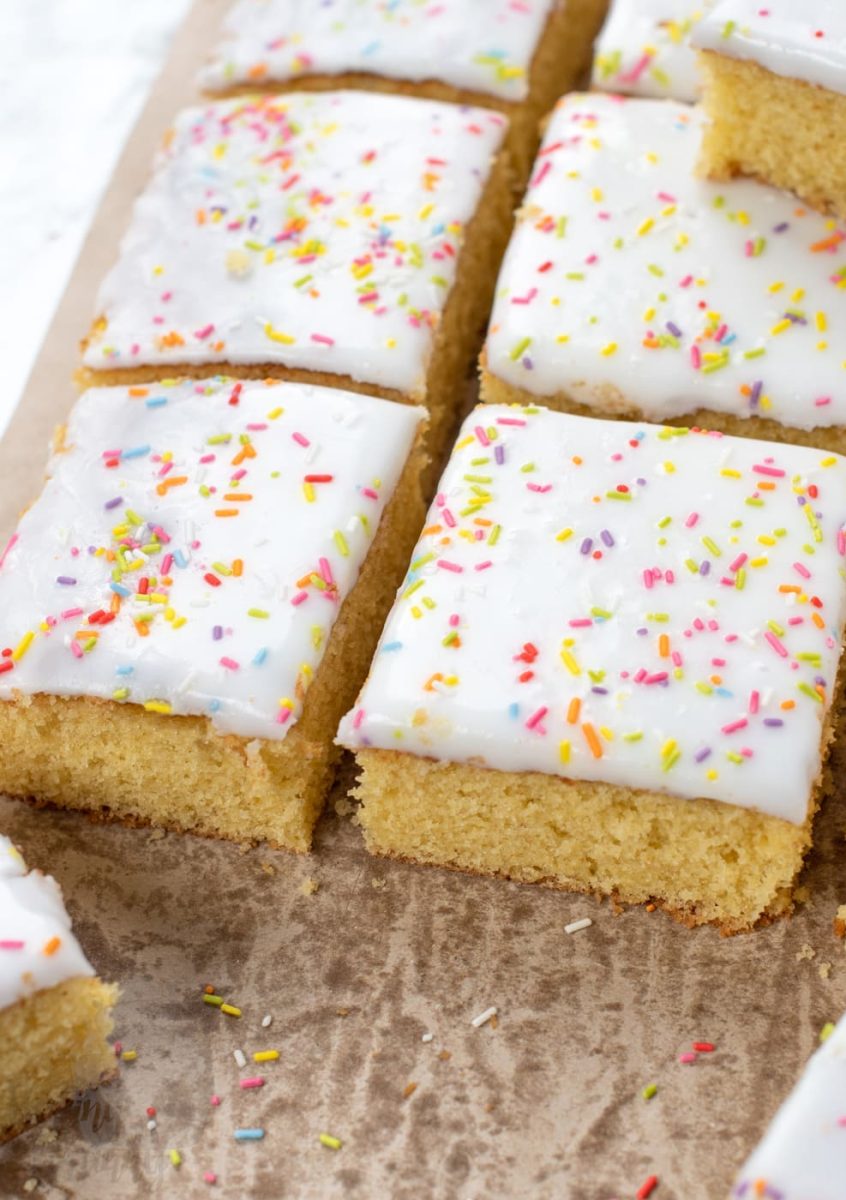
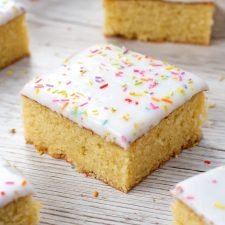
Instantly recognisable, this basic sponge is topped with a layer of icing and a generous amount of sprinkles. And that’s it… Nothing overly fancy, but delicious enough to have an entire dinner hall of kids buzzing with excitement, and praying there will be at least enough cake until their spot in the line.
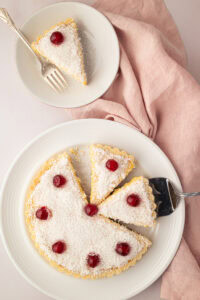
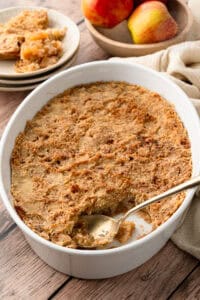
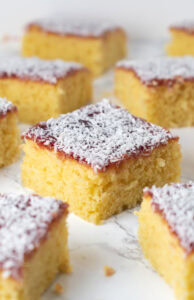
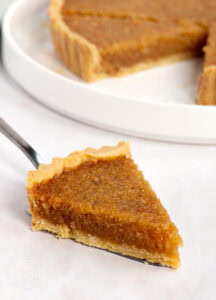
If you loved School Cake, try my recipes for Manchester Tart, Apple Crumble, Cornflake Tart and Jam & Coconut School Cake for even more school-dinner nostalgia.
Tips for the Best School Cake:
- Use Room Temperature Ingredients: Ensure your margarine/butter and eggs are at room temperature before starting. This helps the batter mix more evenly and will give a better, more predictable rise.
- Don’t Overmix the Cake Batter: After adding the flour, fold the batter until just combined. Overmixing can make the sponge cake dense in texture, instead of light and fluffy.
- Test for Doneness: You know the sponge is ready when it’s golden on top, and a skewer inserted in the middle comes out clean. Avoid opening the oven too early or too often; otherwise, the cake might sink in the middle.
- Bake in Advance: Bake your sponge the night before you need it. Once cool, leave it on greaseproof paper on a wire cooling rack and place it in an airtight bag. Decorate with the icing and sprinkles in the morning. This will give your cake a better and easier-to-work-with texture overall. Just trust me!
- Cool Before Icing: Let the cake cool completely before adding the icing and sprinkles; otherwise, the icing will melt and slide right off!
- Avoid Supermarket Sprinkles: If you are in the UK, you’ll probably find the supermarket sprinkles are not what they used to be and are somewhat anaemic. It’s always worth sourcing brighter sprinkles for an authentic School Cake experience.
Free-from & Vegan
Amy recommends: If you regularly need to adapt baking recipes for gluten-free, dairy-free, egg-free or vegan diets, I highly recommend The Elements of Baking by Katarina Cermelj, creator of The Loopy Whisk. It’s a brilliant resource for understanding how substitutions work, rather than simply swapping ingredients and hoping for the best.
Gluten-free Options:
Swap the self-raising flour for a gluten-free self-raising flour. As with most simple sponge cakes, this is a fairly straightforward swap, although different gluten-free flour blends can give slightly different results.
Nut-free Adjustments:
This recipe contains no nuts, but as always, be sure to double-check the allergen lists for your individual ingredients.
Dairy-free Swaps:
Simply use a dairy-free baking margarine instead of butter. The remaining ingredients in the cake are naturally dairy-free, but be sure to check the labels on your sprinkles and other packaged ingredients.
Egg-Free Adaptations:
Because this sponge uses five eggs, I wouldn’t recommend simply replacing them with an egg substitute – I haven’t tested this recipe egg-free, and the eggs play an important part in the structure of the cake. Instead, I would start with a tested egg-free plain sponge recipe, such as The Baking Explorer’s Vegan Victoria Sponge Cake, then use the baked sponge as the base for your icing and sprinkles topping.
Vegan Substitutions:
For a vegan version, I’d take the same approach rather than trying to adapt this five-egg sponge. The Baking Explorer’s Vegan Victoria Sponge Cake is both egg-free and dairy-free, so you could use a tested vegan sponge recipe like this as your starting point, then finish it with the icing and sprinkles. Just be sure to check that the sprinkles and any other ingredients you use are also suitable for a vegan diet.
Allergy Disclaimer & Resources:
Any advice or suggestions to make recipes “free-from” or vegan are purely suggestions. Please double-check all packaged ingredients individually, taking extra caution when baking for those with allergies or intolerances.
For official guidance on food allergies, please see Food Standards Agency (food.gov.uk) | For more info on coeliac disease, please see Coeliac UK (coeliac.org.uk) | For more info on a vegan diet, please see The Vegan Society (vegansociety.com)
School Cake FAQs
School Cake gets its name from the fact that it is the sheet cake that would be served with school dinners across the UK. Traditional school cake is a simple, plain sponge, topped with a white water icing, and finished with rainbow sprinkles. It can either be served as is, or with a splash of custard – either normal yellow custard, or sometimes pink custard!
Yes, you can use butter instead of margarine in this old-school cake recipe, but I prefer margarine as it gives a lighter, fluffier sponge, whilst also being the more traditional option. I explain this in more depth in my Margarine Ingredient Guide. Whichever you choose, just make sure it’s softened before you start.
Yes! You can absolutely use plain flour in place of self-raising flour in a school cake, but you will need to add the raising agents that you would usually find in self-raising flour.
The general rule of thumb is to add 2 teaspoons of baking powder for every 150g of plain flour.
So, in this recipe, you would use 3½ teaspoons of baking powder as there is 280g of flour.
Yes, you could certainly try an egg replacer (like a chia seed or flaxseed “egg”), or use 60g mashed banana or applesauce per egg. The texture and flavour may be slightly different, but still tasty!
Absolutely! Once baked and cooled (and before icing), wrap the sponge cake in cling film and tinfoil, then freeze for up to 3 months. Defrost fully at room temperature before icing and serving.
More School Dinner Recipes
If you loved this School Cake, here are some more of my favourite school dinner recipes for you to try next:
Save this recipe!
Want to save this recipe for later? Pop your email below and come back to it when you’re ready to bake.
School Cake
INGREDIENTS
- 280 g Soft Margarine (or Butter) (at room temperature)
- 280 g Caster Sugar
- 5 Free-range Eggs (at room temperature; see Egg Size notes below)
- 280 g Self-raising Flour (see Self-raising Flour note below)
- 350 g Icing Sugar
- 3-4 tbsp Boiling Water
- Sprinkles (to decorate – optional)
EQUIPMENT
INSTRUCTIONS
- Preheat your oven to 180°C (160°C for fan-assisted ovens, Gas Mark 4 or 350°F) and line a 20×30cm (9×12 inch) baking tin with greaseproof paper. Set aside.
- In a large bowl, cream together the margarine and sugar until light and fluffy in both colour and texture.280 g Soft Margarine (or Butter); 280 g Caster Sugar
- Add the eggs one at a time, ensuring each is mixed through before adding the next.5 Free-range Eggs
- Sift in the flour and gently fold to create a batter.280 g Self-raising Flour
- Transfer the batter to your pre-lined tin and bake in your preheated oven for 30-40 minutes until risen, golden in colour, and a skewer inserted comes out clean.
- Leave to cool in the tin for a few minutes before transferring to a wire cooling rack to cool completely.
- Once your cake has cooled completely, in a bowl, mix the
icing sugar with a few teaspoons of boiling water, adding a little water at a time until you have a thick, pourable consistency. Pour the icing onto the top of your cake, using a spoon or palette knife to guide it to the edges. Finish with some rainbow sprinkles.350 g Icing Sugar; 3-4 tbsp Boiling Water; Sprinkles
VIDEO
IMPORTANT NOTE:
All my recipes are developed using a digital scale and the metric system (grams and millilitres). Cup measurements are available as a conversion but these, unfortunately, won’t always be as accurate. For best results, I always recommend baking with a digital scale.
RECIPE NOTES:
Substitutions:
- Margarine: I use a soft baking margarine in most of my sponge cakes because I find it easier & more predictable to use – I go into more detail about this in my Margarine Ingredient Guide. However, you can swap this out for unsalted butter, particularly if you are baking outside the UK, where margarine quality can vary considerably.
- Caster Sugar: When it comes to sponge cakes, caster sugar is preferable as the finer consistency is ideal for mixing through the batter. In a pinch, you could swap it for granulated sugar. For more information, see my Caster Sugar Ingredient Guide.
Tried this recipe?
Tag @bakingwithgranny or use the hashtag #bakingwithgranny!Originally published in July 2020.